“When do you plan to retire?”
“Your Retirement Equation” will help you answer that question. If you ask an average person when they plan to retire, they will likely give you an answer based on time. You’ll likely here answer like: “Sixty-five”, “Sixty-seven”, “When Social Security kicks in” or “In five years”. That’s how future retirement is typically framed – as a moment in time. However, retirement doesn’t depend on your age, the calendar or a specific birthday. Retirement can begin when the numbers work.
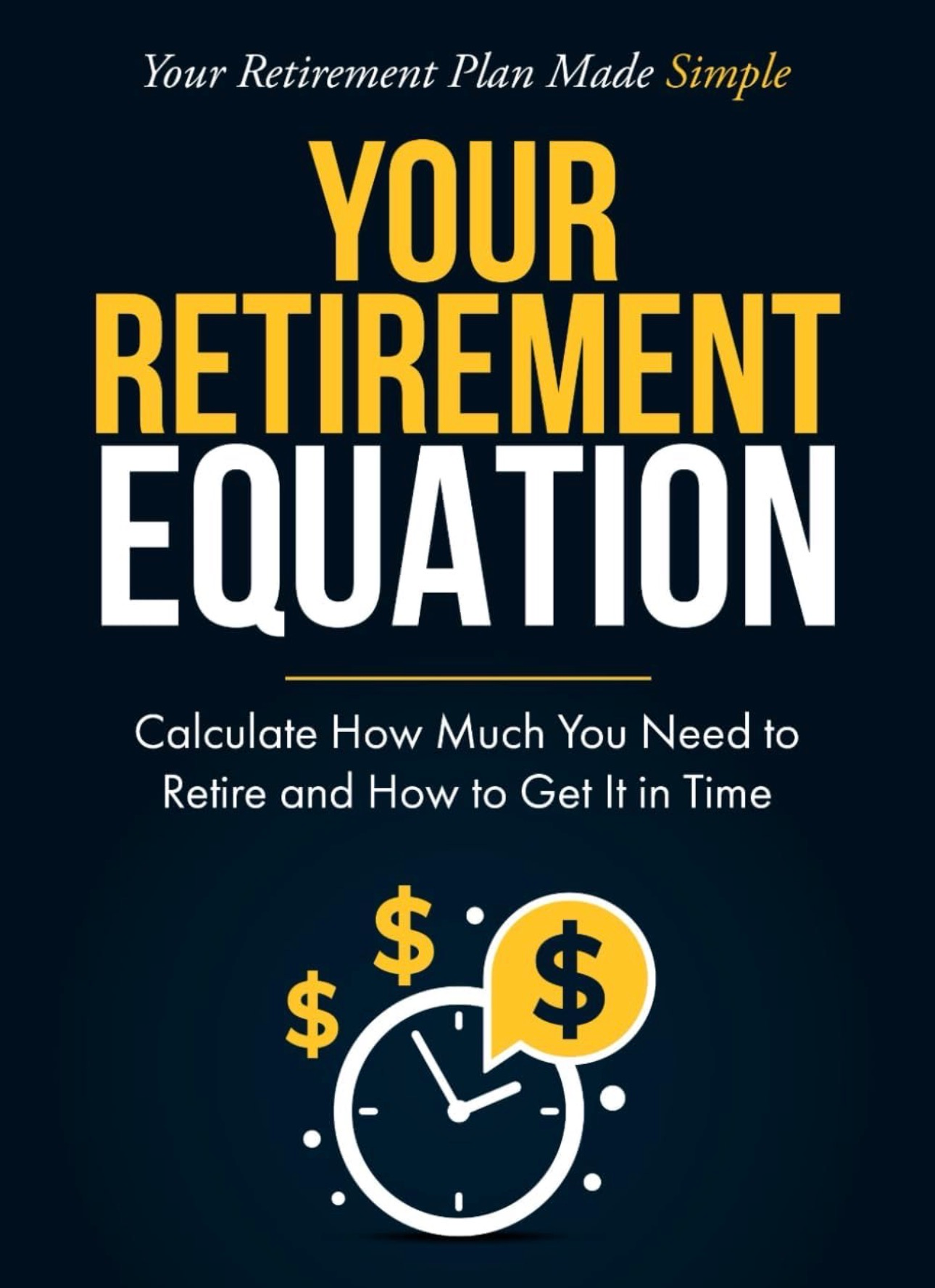
 That’s the core idea behind this blog, “Your Retirement Equation” and the book by the same name. (See book here). The book originated from my own journey in retirement planning. In it, I lay out the steps that I took to reach retirement. Topics covered included debt management, wealth accumulation, withdrawal strategies, tax optimization, index fund investing and more. I hope to discuss these and many other topics here in future posts.
Retirement isn’t about how old you are. It’s about what your financial equation looks like. It depends whether that equation allows you to support yourself without relying on a biweekly paycheck. You don’t retire because the calendar says you can. You retire because the numbers say you can.
What Reenforces This Misconception About Age?
Over time, we absorb the idea that retirement is something you reach at a certain age. This misconception is reinforced by Social Security’s “full retirement age”, Medicare’s eligibility age of 65, and pension plans being linked to your age and years of service. However, reaching “full retirement age” or “20 years of service” doesn’t pay the bills.
Two individuals who have reached “full retirement age” (let’s say 67) can be in very different financial situations. The first may be financially independent (and may have able retired years earlier). The second may be living paycheck-to-paycheck. The second person’s annual expenses will be not likely be covered solely by Social Security. (According to the Social Security Administration, the average monthly Social Security benefit, as of January 2026, is $2,071.) That person will likely need to continue working… and saving… for several more years.
When Can I Retire?
 Reaching a certain age doesn’t unlock retirement. It is unlocked by reaching “financial independence,” a term that we will define and discuss in depth in future posts. The right question is not “When do I want to retire?”. Here’s a better question. “At what point do my resources reliably and predictably cover my expected expenses, adjusted for risk, taxes, inflation, and time?” We’ll discuss all of these issues in depth in future posts, one by one.
Your current assets, if invested properly, will continue to grow between now and your retirement. In addition, you will likely continue to contribute to your retirement savings with each paycheck as well. In upcoming posts, we’ll predict how this initial investment combined with your future investments will grow. To do this, we’ll use historical averages and some simple math. (Don’t worry. There won’t be any trigonometry or calculus. Just some simple math.)
By using these predictions, you will be able to approximate your retirement date. It won’t be based on your age, but when you have reached “financial independence.”
Retirement is Triggered by a Number, Not an Age
When you realize that retirement isn’t an age, but a number, the possibilities become obvious. You may come to the marvelous realization that you can retire earlier than you ever imagined. Your retirement won’t be bases on age, the calendar or years of service. Your retirement decision will be firmly based on the fact that you are no longer dependent on the income from your job. This knowledge will allow you to retire with confidence.
However, this “number” isn’t simply one number. It’s a set of interconnected numbers:
- Predicted annual spending
- Income sources (Social Security, Pension, Real Estate income)
- Investment assets
- Asset allocation
- Asset location
- Withdrawal rate
- Taxes
- Healthcare costs
- Long term care insurance/costs
- Debt obligations
- Inflation
- Market fluctuations
- Longevity assumptions
- Flexibility in spending
Each of these play a role in the equation. We’ll discuss these and many other issues in future post on “Your Retirement Equation.”
How Much Do I Need to Retire?
Many uninformed, aspiring retirees will say something like: “I need $1.7 million.” This $1.7 million comes from the average amount 1,000 workers told Schwab they needed to retire in 2022. These workers didn’t come up with number after some lengthy, detailed analysis. Nor was it based on their current spending habits, future expenses or projected earnings. They pulled out of thin air. In fact, according to Federal Reserve, the average retirement savings (for 65 and 74 year olds) was only $609,230. This is only 36% of what retirees thought they needed. Don’t use either of these numbers for your calculations. I can guarantee that they are both wrong… for you.
The informed, aspiring retiree says: “I need my resources to reliably produce enough money to cover my annual expenses, after taxes, for as long as I live, with room for uncertainty.” He/she will then use the equation to calculate the amount they need and the timeline to get it.
This blog is built around the equation that makes that possible to accurately calculate your number, not just an arbitrary, often inflated number.
What is Your Retirement Equation?
 To outline your retirement equation, you’ll need to learn some things about yourself and your lifestyle. The most basic is “How much do you spend each year?” Surprising few aspiring retirees know this number. The next question is “How will my spending change in retirement?”. These two questions are foundational to all future calculations in determining your “number.” This “number” is the amount of money you need to safely retire. Everyone’s “number” is different.
Each future post will target a small, but important, piece of the equation. You’ll see how each piece will fit into your retirement equation. Don’t get discouraged. It’s actually a lot simpler than it sounds (and many make it feel).
Do I Need a Financial Advisor?
The entire retirement planning industry has made the whole concept investing seem scary and complex. This is likely by design. The idea is to make investing for retirement seem complicated while touting their own “expertise.” They suggest that only they can guide you through the maze and “beat the market”….. for a fee.
Let me let you in on a little secret about them “beating the market.” They can’t. In fact, only 8% of actively managed funds beat the S&P 500 over 20 years ending in 2024 (SPIVA US Scorecard). In addition, it is not likely that that 8% will be the same 8% to beat the market over the next 20 years. Do you think you can pick one of the 8% of fund managers that might beat the S&P 500 in 2026. I know I can’t. However, I do know, that by investing in the entire market, I can match the market.
“Your Retirement Equation” will discuss the benefits of avoiding actively managed funds, with their exorbitant fees, higher taxes and worse results. This is obtained by investing in total market index funds. Over time, I hope that you will gain the confidence to fire your fund manager, stop paying the fees and do it yourself. In reality, it’s easier than your think…. and, on average, you’ll have better results.
About the Author:
I’m not a Certified Financial Planner (CFP) or a Certified Public Accountant (CPA). During a thirty-year career, I tried to lived below his means, saved and invested the difference and avoided debt when possible. I used the information that is outlined in the book (“Your Retirement Equation”) to confidently retire at the age of 56.
Early on, I invested with “financial advisors” who did very little, but took 1% or more of my slowing growing portfolio every year. As my portfolio grew, that 1% became a significant amount. As my career continued, and my retirement approached, I began to learn more investing and retirement planning. I learned more about 401K’s, IRA’s, HSA’s, taxes and market volatility. Most importantly, I learned the devastating affect those 1% fees had on the growth of my portfolio and pending retirement. I learned about the significant conflict of interests that most “financial advisors” have and how to avoid them.
Actively Managed Funds and Fees
I learned that actively managed funds, like the ones I was invested in, failed to beat the market approximately 92% of the time. I fired my advisor and moved my investments to Vanguard, investing in total market index funds and broad bond index funds. This reduced the fees to approximately 0.04% (a fracture of what I was paying before) and completely eliminated the conflict of interest. I learned how to managing my own investments, through organizations like Vanguard. (It’s a lot easier than you might thick.)
As I learned more and more, I began to compile the information into a plan, much like a business plan. The goal of this plan was my own retirement. Later, this plan was formalized and became a book entitled “Your Retirement Equation,” published in September of 2024. This blog is an extension of that publication.
Learning Over Time
Over the years, I learned that the market goes up and the market goes down in the short term. However, I also learn that the market always goes up…… eventually. In the future, I will ride the ups and downs of the market with confidence. I have gradually accumulated resources to reliably produce enough money per year to cover my expenses, after taxes, for as long a I live, with room for uncertainty.
Your equation will be exactly like mine. Your ability to ride the roller coaster of the market won’t be the same as mine. However, you can learn to manage your own investments. You can use the same equation to accumulate enough to retire safely and comfortably.
Sign Up:
What topics would you like to hear about? Let me know in the message box below. These messages will help guide the posts to the most helpful topics.
Error: Contact form not found.
The information contained in this blog, including this post and future posts, is the author’s opinion and does not constitute any investment, retirement planning or tax advice. This blog should be used for informational and entertainment purposes only. Consult your financial planning or tax professional before making any investment, retirement, or tax decisions.